There’s a pretty popular YouTube short here making the rounds with the title “You Have a 0% Chance of Beating Magnus Carlsen.” Though the core claim is arguably true – an average player statistically (yes, I just used Reddit as a source) has a 0% chance of beating Magnus Carlsen from the way Elo works – my issue is in the claims the video makes to get there.
Yes, chess grandmasters use a technique called chunking…but so do players at much lower levels. As impressive as chess grandmasters are to ordinary players like me, I think videos like this perpetuate the myth that they have superhuman abilities. In this TED Talk, grandmaster Maurice Ashley explains that it is a myth that grandmasters have the ability to see 10-15 moves into the future. It’s position-based. In some common positions, high-level players can see exactly how many moves there are to checkmate. In others, there are simply too many possibilities for even grandmasters to consider.
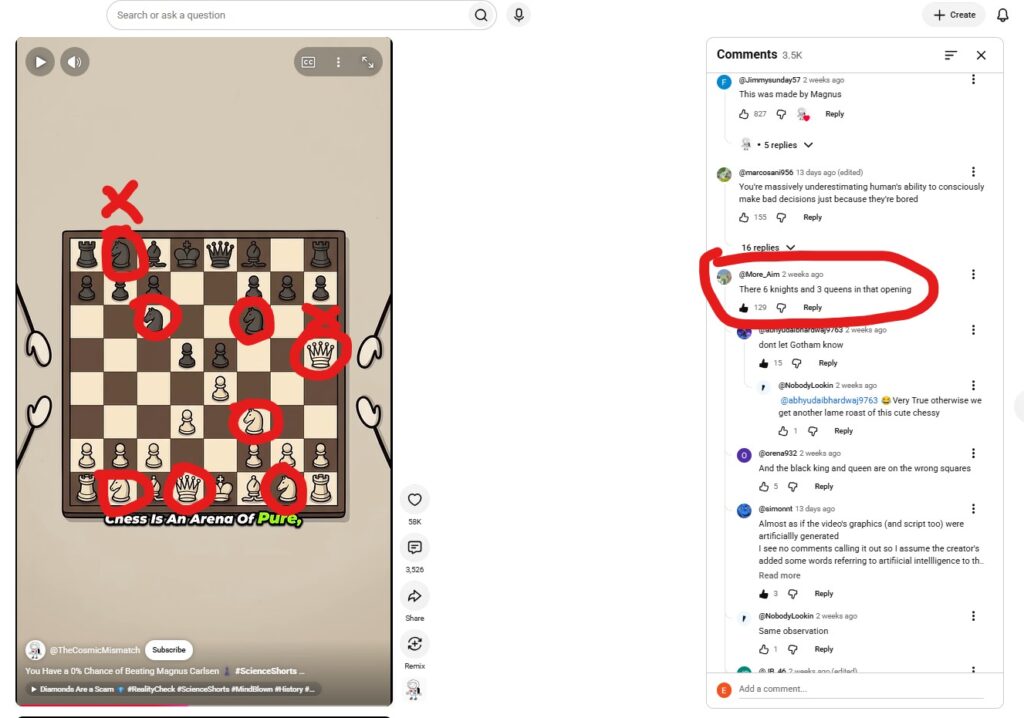
In case all of this alone does not win any arguments, most of the images in the video are AI-generated and non-sensical. Take, for example, the screenshot above.
Chess Engine
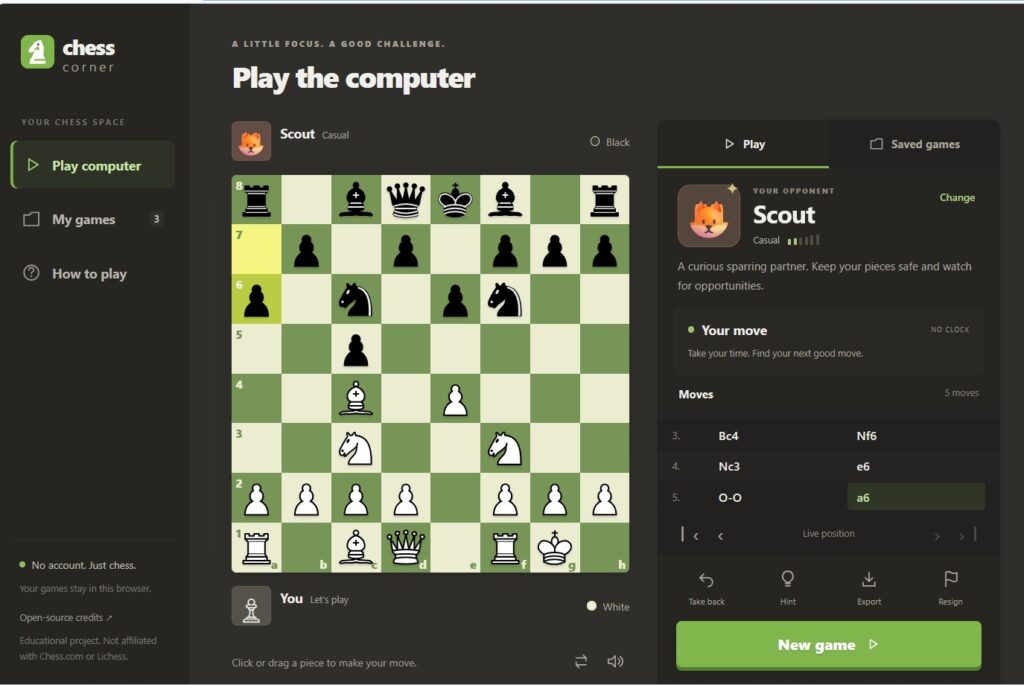
I’m still running Codex with the ChatGPT Plus subscription, and it more or less “one-shotted” a chess game with a prompt that was something like, “Look up chess.com against AI and clone it.” What it came up with was a good deal different from chess.com, ie worse.
Go on a Reddit space like webdevelopers, and vibe coding has a certain….I don’t want to say “stigma,” since the word stigma implies unfairness, and many arguments against vibe coding are completely legitimate. Just try the webpage out, the argument goes, and you will begin to see some obvious flaws.
I did, but they were interesting. The chess AI took advantage of Stockfish, and I found it quite good. I could only beat it at the lowest level. I also found the source code to be completely incomprehensible and spent a fair number of tokens translating the whole thing into Typescript/React, just so I could read the thing.
fdimport { Chess, type Color } from 'chess.js';
import type { GameStorage, Level, Library, MoveInput, Outcome, SavedGame } from './types';

export const LEVELS: Level[] = [
  {
    id: 'beginner',
    name: 'Sprout',
    label: 'Beginner',
    skill: 0,
    depth: 1,
    time: 120,
    icon: '🌱',
    color: '#88a85a',
    description: 'A gentle place to start. Take your time, try ideas, and find your rhythm.',
  },
  {
    id: 'casual',
    name: 'Scout',
    label: 'Casual',
    skill: 2,
    depth: 3,
    time: 220,
    icon: '🦊',
    color: '#c08956',
    description: 'A curious sparring partner. Keep your pieces safe and watch for opportunities.',
  },
There’s still a lot of stuff like this going on. AI always seems to do this. Instead of using Material Design or something, it literally uses emojis for its icons. I don’t know for sure if this is a violation of accessibility requirements, but I mean….could be the tip of the iceberg, really.
The thing is pretty slow to run because it requires the user to run npm from VSCode. Because of that I had the idea to prompt the thing to be shared on GitHub pages. And it is…but I don’t know if I want to share it.
Since GitHub pages relies on a static backend, this webpage stores game state and ALL PGN files in local storage. Games should hypothetically be quite small, but random users may find it taking up too much of their browser memory.
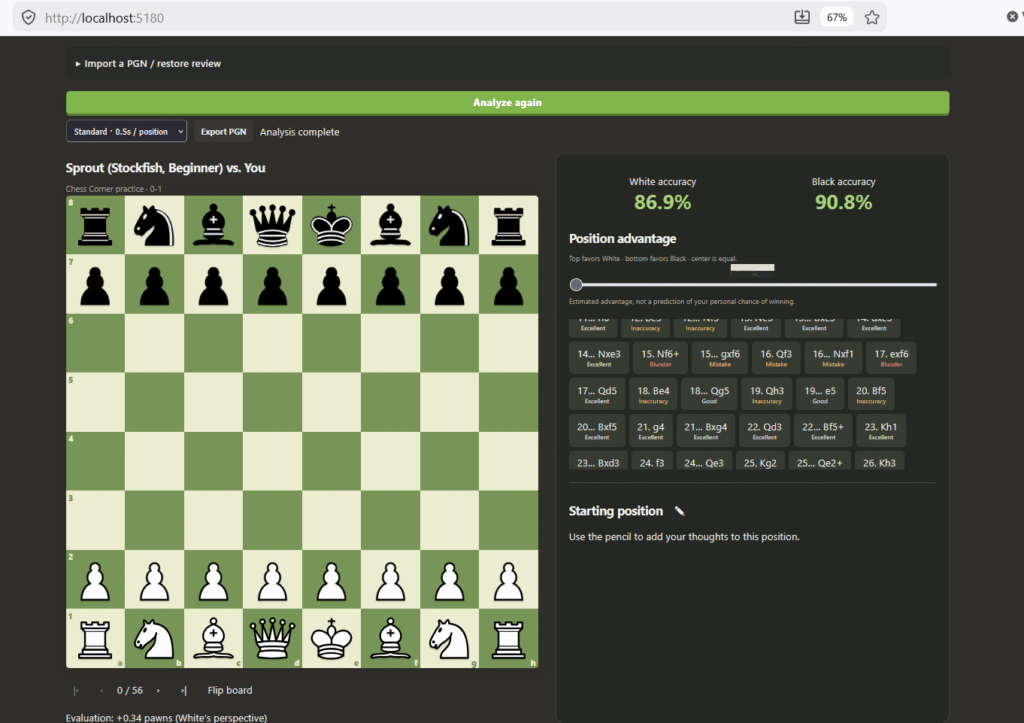
Then I added a chess analysis feature, which was kind of the point of this. Chess.com restricts free users to a limited number of chess analysis runs per day; Lichess has no such limitation, making this whole exercise arguably pointless, but oh well.
At a glance, on a different game from this, the analysis was nonsensical and probably the result of AI slop. Was it just making percentages up? But actually, compared to Lichess it seemed to pick up similar moves. So maybe it’s not crazy, but I would want to analyze it a bit.
Closing Thoughts
I guess that maybe the issue I have with the YouTube short above is that it seems to equate chess with intelligence. Why are grandmasters so good? Sure, they have a seemingly superhuman ability to predict the future using memory techniques. But that’s just it. Predict. They attempt to calculate the probable future, their opponent does the same, and theoretically whoever makes better logical predictions has the advantage.
That’s the beauty of chess. Anyone can play the game, and the Elo system allows us to have a fun experience regardless of our level.