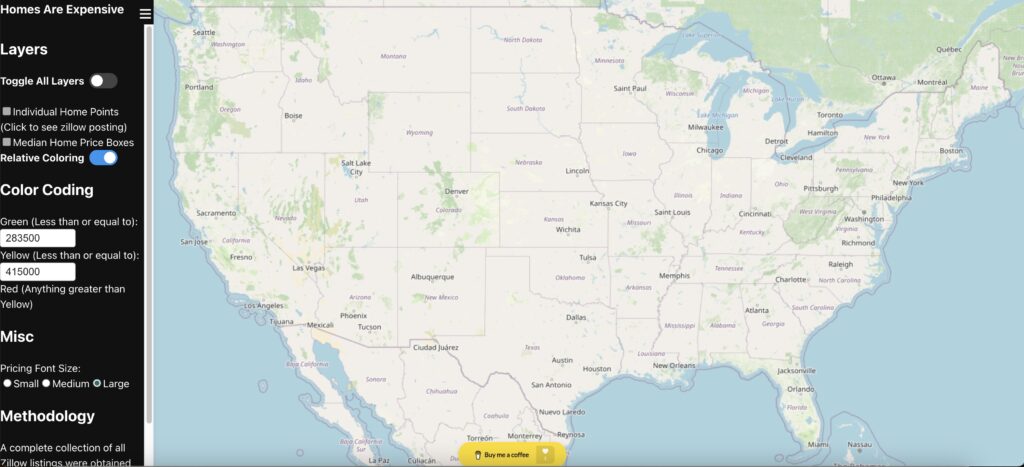
About six weeks ago, Smack (which is the name I will be referring to from now on, even though his name is right on the website) got a lot of attention on r/dataisbeautiful for a website he had made. He was house hunting, so he purchased some Zillow data for California and a few other states, scraped it, and mapped the results onto a website he was hosting with Hostinger. Within the first hour he was already getting comments, not all of which were positive, but as the night went on the reception seemed extremely positive. It ended up getting 2000 upvotes, thousands of unique users (according to his data), and even a $25 donation from someone satisfied with his work. It got so much attention that they granted him free access to reuse the API, and many people requested that he extend his data set to the rest of the country. In other words, it was a slam dunk and basically went as well as we could have imagined.
The only thing I had to possibly be disappointed about was that I had absolutely fk nothing to do with any of it.
The State Of The Website (And A Call For An Upgrade)
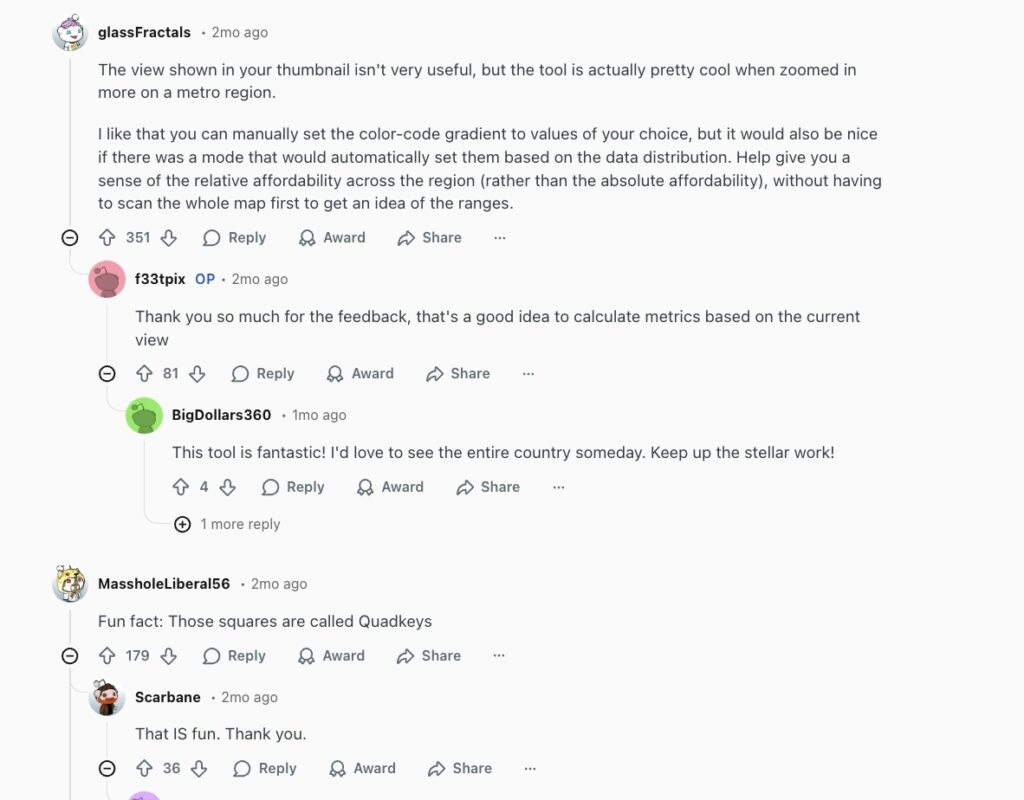
The next morning, Smack messaged me to ask if I wanted to take the project over. That’s…kind of what happened. I have worked to implement his requests, with tremendous help. I plan to share the website URL later (even though it is already out there, via Reddit), but as it stands it is not very stable.
The night it was uploaded, the website proved to be pretty robust (especially considering that it was hosted on a single core). It encompassed just a few states. Now it encompasses the entire country, which brought on more lag, and I was dismayed to find that my frontend feature was contributing to the lag. Smack rewrote the entire backend in Golang from its initial Python, and we recently have been going back-and-forth on county coloring. I am not sure how the performance will be when the dust settles from this epic tug-of-war between Smack’s backend changes and my frontend…change.
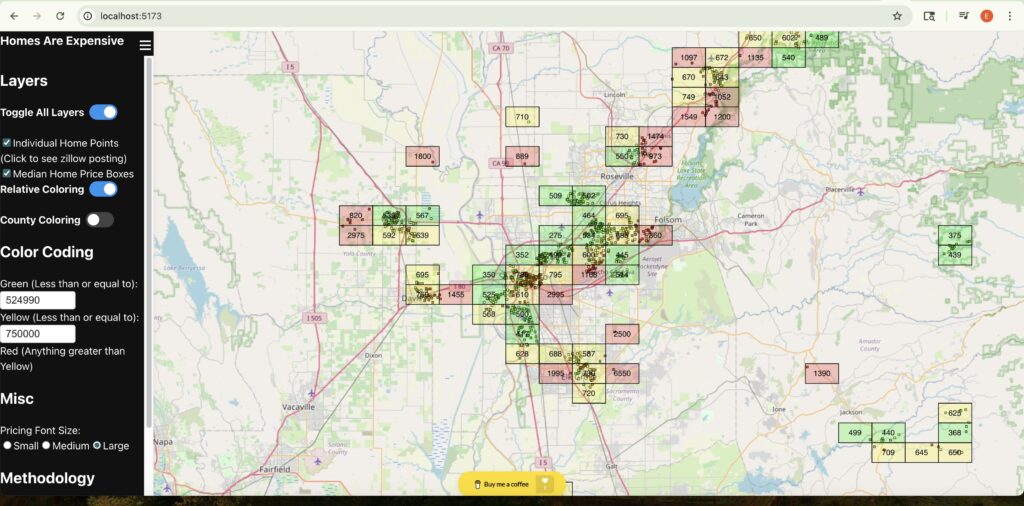
The frontend was one thing a few Reddit users criticized, possibly because of the boxes. The more I worked with county data, the more the boxes grew on me – they automatically readjust whenever you move areas. Now that I (well, with a little help from Sam Altman…and one thing I want to discuss on this blog are the dangers of AI-generated code I tried to add on a base that Smack initially wrote without AI) added relative coloring, these values automatically recolor relative to where you put your screen. Zoom in on San Francisco? “Red” will be very different than what it would be in the Sacramento region (above…add three zeros to the numbers for the house prices to make sense). Users requested county coloring, but these boxes will adjust no matter where the user is zoomed – they can be the size of a house, or the size of multiple cities.
They also asked for county coloring, and that has been…something.
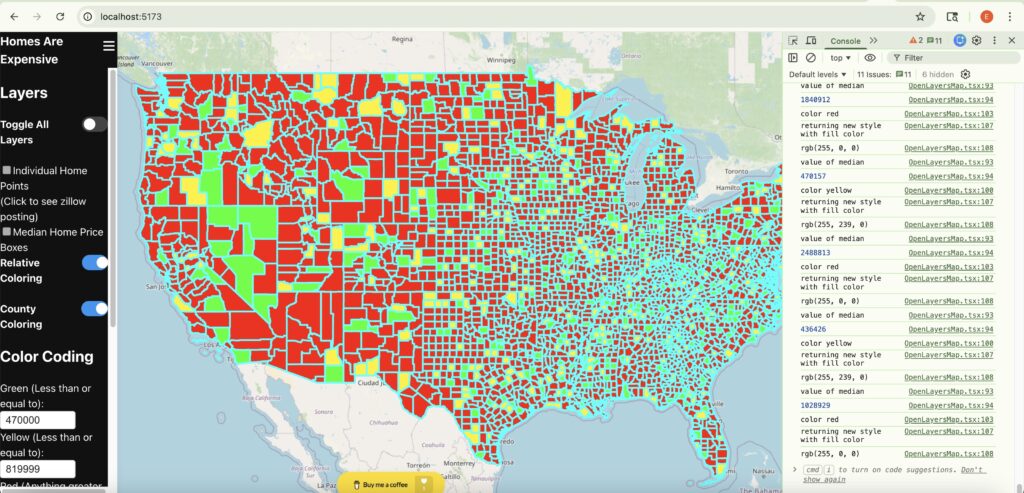
I really like this. Smack doesn’t. I mostly like it because I was unsure if I would make it this far. Smack obtained a shapefile for counties, and with some effort we’ve been working to create a geojson with medians appended (geojson was my idea, not his…I wonder how it would have panned out with another format?). I know the coloring isn’t very pretty (and that’s why he is continuing to work on this), but it took some effort to get the frontend to color in anything at all. This was because of the geojson file. It seemed to be misformatted.
Motivation
Our conversation went something like this:
Smack: You can blog about it right now, I don’t really care about that. What I want is to wipe my hands clean of this
Me: What if I donate money for the hosting bill?
Smack: I’d prefer you actually take the project over. Here’s a list of three things I want you to do within six weeks
Did I fulfill my obligations? We’ll see. He wanted to move on from the project, and I wanted something to milk for blog content. My Medium was going okay, I guess, but I was getting tired of paying for a membership and I wasn’t really practicing what I preached. I was complaining constantly there (and, incidentally, on this blog as well) about content creators (particularly on YouTube, Instagram, and TikTok) who would talk about coding and tech in a vague way, without ever seeming to dive into anything technical. I wanted to have real code to point to, if only to say it was an example of x, y, or z. Smack’s project was something with more than just a useful purpose – it was something people had actually used.
I purchased a 1-core Hostinger setup for a year (so the project will be live for at least another year, that’s my main contribution) and gave Smack access. He quickly added some performance improvements to the backend and then did something he called The Big Scrape to gather home price data for the entire country. If I remember correctly, this was around mid-November. The data itself is what makes the project valuable – not everyone is willing to pay for it. I think Smack was aware that the longer version 2 took, the less people would care about data gathered in mid-November of this year.
Smack owns the catchy domain, but for the time being it is pointed at the virtual machine I rented (or “purchased”? How do we define ownership of a virtual machine?)
The Stack
Unfortunately for me, Smack achieved all this using TypeScript/React, both of which are things I had almost no experience in (for what it’s worth, I use Vue). He also chose to use OpenLayers, not ArcGIS, so we have missed our opportunity to pitch this to Mappy Hour (although I think they closed their Sacramento chapter?) or fulfill my lifelong dream of making a project called CorGIS.
The backend is surprisingly involved for something that looks so frontend-heavy. It was Python rewritten into Golang, and the reason for it is that the amount of data was overwhelming. What you see on the site is always selected points, not everything.
Closing Thoughts
With luck, I will be able to leverage this project to prove to my family once and for all that moving back to the Bay Area is mathematically impossible.
I had also considered pivoting from tech with this as a jumping-off point, describing in detail the fascinating, complex implications of the data. I would blog about what this all means from a financial standpoint, and what light it sheds on the state of this country.
Then I remembered that I don’t know anything about that, so I suppose the first goal is more realistic.