ChatGPT launched in late 2022, but before that GPT-3 was already making the rounds. Someone produced a viral blog post and #1 HackerNews hit with GPT-3, not to make money but to prove a point.
Before ChatGPT, the simplest way to interact with GPT-3 was probably Replika. I wrote a blog post about them in early 2022, a little before ChatGPT was released, but it has since become a source of embarrassment. They put lots of ads in, and I didn’t like having my name associated with chatbots.
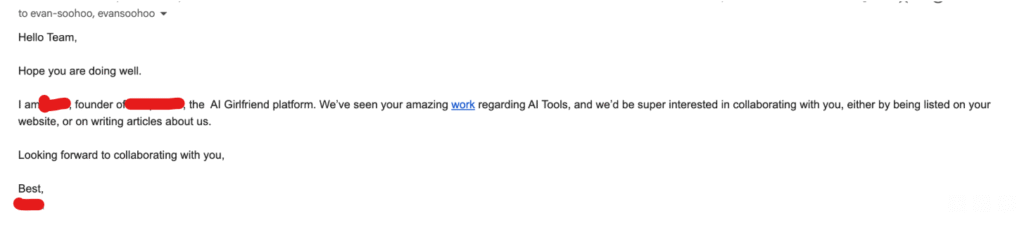
I did get one amusing email from an AI girlfriend company, though.
The Beauty of Imperfection
To call AI-generated writing “too perfect” would feel…off. This is not analogous to lab-grown diamonds, where the artifical thing is essentially the same as the natural product and the only real difference is the source. AI-generated writing is really good, gramatically, and captures the cadence and structure of formal writing. It can tell jokes. It can write poetry and fiction.
Maybe the reason it hasn’t caught on as quickly as some expected, then, is a kind of refutation of The Death Of The Author. Readers actually care quite a bit what a writer had intended to say, and to find out that creative writing was generated is to strip it of all meaning. Who made it? Why did they make it? An AI had no true human comprehension, no genuine emotion, no lived experience. It reminds me a bit of my very limited experience trying out Wattpad and Scribophile – though this may not be a fair representation, it seemed like the people on Scribophile had more life experience. Wattpad stories weren’t terrible – some stories were actually quite good – but I could only get through so many vampire love interests and dreamy Korean pop stars who explicably fell in love with the narrator before it got old. Scribophile users, in contrast, were all over the map. Some were great, some were not good, but they always seemed to have something to say. One writer, I recall, wanted to summarize African folklore he grew up with that had only been shared through word of mouth. Another person was really into hiking, and wanted to use a metaphor to turn it into a spiritual experience.
In other words, sometimes the execution was off but the core ideas were always interesting because they seemed to reflect real experiences and thoughts.
I find it odd that to determine if something was human-written, I find myself looking for grammatical errors. I find it odd that to determine if code was AI-generated, my first instinct is to look for useless comments. There are some things that AI is good at matching, but what I think it does best is churn out writing that perfectly says nothing. It’s like corporate emails that target everyone to the point of saying nothing. Everything seems perfectly filtered, perfectly cleaned to the point that any substance is removed for fear of repercussions.
Saying Something
My writing has been criticized for rambling, and I will not push back on this. “Be concise. Don’t waste my time.” Very well.
I could write about the therapeutic nature of putting thoughts on paper, or reflect on my indecision whether to add spell check to this site (if I include obvious spelling errors, no one will ever accuse me of AI-generating anything!). I could write about why writing is an enjoyable activity, but everyone I find who does this either already enjoys writing, or dislikes it so much that they are trying to write their way into loving it.
Real human writing has substance and intention, no matter how poor the execution may be. AI writing is a little more like AI code – it serves a purpose but is more like the means to an end. In a lab-perfect AI world, AI-generated code would be so seamless and secure and bug-free that it would become invisible. Humans would have no need to look at any of it, it would just work and create things that they interacted with. Whether we can get to an ideal lab world with no need for coders is a subject of debate.
But writing…writing is meant to be consumed. It says something, it means something, it informs and entertains. In an ideal AI lab world, humans would still write to express themselves. To say otherwise would be a bit like arguing that no one should draw because we can simply take photographs.