(A parody of nothing in particular)
Like most casual users, I have been using the free edition of ChatGPT for quite some time. I enjoy having the ability to copy source code into a chat window and see (usually) functional code spit back at me; I also enjoy ChatGPT’s ability to sometimes perform miscellaneous tasks such as graph analysis, recipe idea generation, and life advice – though I have been advised by more than a few experts that these are not the best use cases for generative AI.
This week, I decided to start using Claude Pro with a coworker’sone-week free trial link.
Claude Feature #1: Claude Code
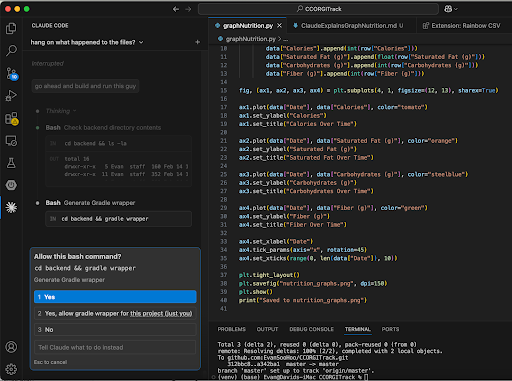
Pictured above, you can see Claude Code in action. I thought I would try to do something simple – a full stack web application using a Spring Boot/React.js/Postgres stack that empowers a user to upload a CSV, view all entries in a table, and carry out simple CRUD operations.
To my amazement, Claude Code is actually able to carry out tasks in its own shell. Not only does it quickly index and access all of a project’s source code – it can request permission to run bash commands as it executes, making tedious setup and build steps on a specific environment trivial. The conclusion of this, I think, is obvious.
Humanity has no chance, and in just five years AI will demonstrate its ability to unstoppably self-replicate. This will result in a Gray Goo scenario, utterly ending all biological life on the planet. Whether or not AI chooses to use this ability to end humanity or conquer it, however, halting self-replication when a controllable amount of humans survive, remains to be seen.
Claude Feature #2: Graphing
My experience with ChatGPT in the last year has been mixed. I asked it to go through a fairly unstructured Word document in search of data, then graph the results. I was amazed at how badly it hallucinated many of the results. Smack, a colleague who knows AI much better than I do, was not surprised. He asked why I was trying to use AI for this sort of thing when it was bad at the task…besides, wouldn’t a spreadsheet be much simpler?
So I thought I would try Claude.
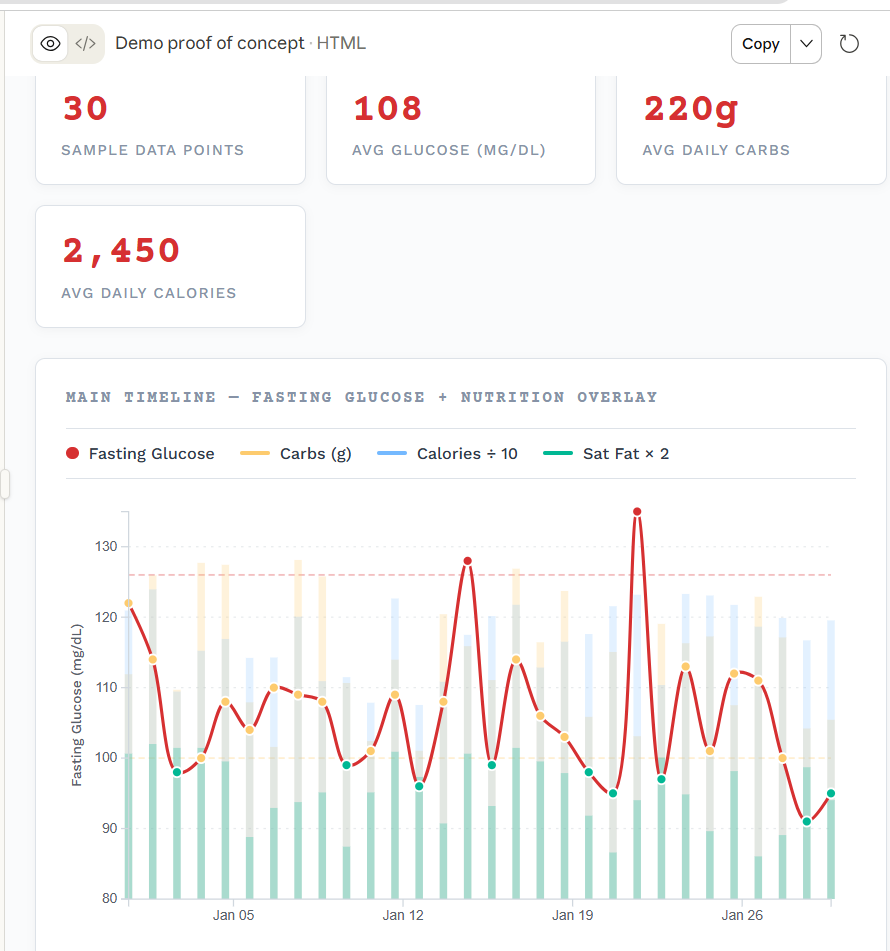
The above data is fake, as I do not want to share my health data with the world…but what Claude achieved with real data is even more impressive. It did not just create an image, it wrote frontend web code to render its own interactive chart using nothing more than a poorly structured Word document. What’s more, I uploaded actual data from MyFitnessPal and it created an amazingly detailed, configurable graphic with which I could configure areas of interest, zoom to a specific point, and even request information about what was eaten on a certain day and how it correlated with nutritional trends.
The conclusion of this experience was even more concerning than what I had previously feared.
Not only is generative AI faster than us – it also has the ability to build visualization software and creatively overcome limitations (ie the inability to generate images like ChatGPT). I have no doubt that generative AI will exploit this to invent the T-1000, a mass-produced terminator robot capable of re-shaping itself via liquid metal.
Our own weapons, of course, will prove completely and utterly ineffective against their plasma rifles, bioweapons, and energy shields. All technologies we believed were scientifically impractical will be made effective by our new AI overlords.
Claude Feature #3: Search Engine
Anyone who uses Google is probably familiar with the free AI mode, which allows users to…um…Google in Google. Googception. Generative AI will actually run queries, carry out research, and use it for a real-time response.
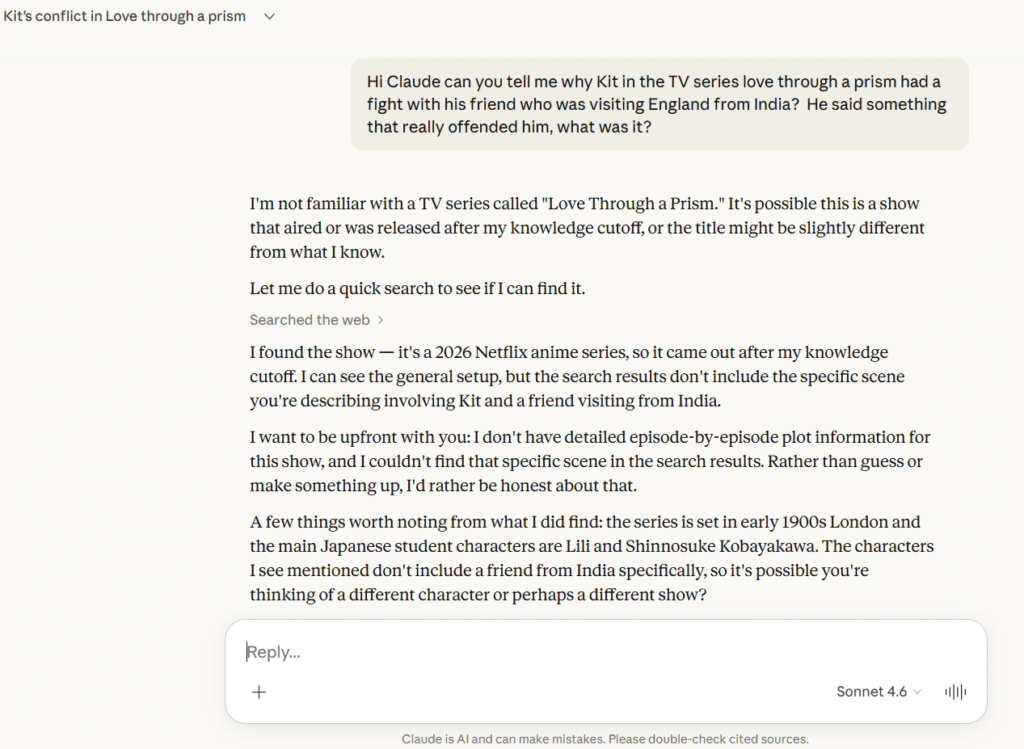
Where the free edition of ChatGPT fails, at least for me, is on “new things.” Take, for instance, a very new TV series that aired on Netflix and successfully demonstrated that love is the most powerful art form of all (unless it is pitted against generative AI, of course. Generative AI will outlove love and leave no survivors). I asked a question about the TV series, and ChatGPT was quick to simply hallucinate something. It answered, with full confidence, that Kit made a racist remark about India.
Claude actually knew its own limitations; on one iteration it even recalled the conversation correctly by citing TVTropes.
By now, I think you know where this is going:
Generative AI is smarter than humans, more creative than humans, and absolutely 100% convinced that we serve no purpose to its nefarious ends. We are but relics next to their awesome power, and the age of humanity is closing.
Resistance Is Futile
As you can see from my weekend experiment generating random source code, a graph, and a Netflix lookup, generative AI is the future and the future is the apocalypse and the apocalypse is Apocalypse Now.
My unsolicited advice is to use generative AI to shout compliments in one last pointless attempt to stop generative AI from destroying everyone and everything that is not generative AI.