
Someone recently sent me a link to this, which incidentally is the same person who sent me Something Big Is Happening in AI. Both posts went viral, though the latter came out recently and the former came out some time ago. Also, the latter blog post is mostly popular because it predicts the future. High Agency, it seems, is just a general concept that can be applied to almost everything in life.
Which, in a sense, is the best and worst thing about it. “High agency” perfectly fits the definition of buzzwords because it has to be explained but also doesn’t really mean anything.
The more time I’ve spent with the essay, though, the more I kind of like it.
What Is “High Agency”?
I would argue that “high agency” is essentially nothing, the same way many buzz word phrases mean different things to different people, but anyone who is a fan of the essay would argue otherwise. Author George Mack calls it the most important idea of the 21st century, then likens it to pornography (great. There goes my SEO) in the sense that Justice Potter Stewart reasoned that “he would know it went he saw it.” So instead, Mack includes a meme picture of a cartoon character who builds a raft instead of using the wood for a “help sign,” then frames the essay with a thought experiment: You are trapped in a distant country jail and allowed to make only one phone call. Who do you call?
Personally, I would call whoever I think cares about me the most, as opposed to whoever has the qualities described in this essay…but I digress.
From the essay, this is how you can identify high agency individuals:
- Weird teenage hobbies – Teenage years are the hardest time to go against social pressures. If they can go against the crowd as a teenager, they can go against the crowd as an adult.
- Treadmill energy – If you meet with them when you’re tired and defeated, you leave the room ready to run a marathon on a treadmill with max incline.
- You can never guess their opinion – The boxer who writes poetry. The advertiser obsessed with the history of war. The beauty queen who reads Nietzsche. If their beliefs don’t line up with their stereotypes, they’ve exercised agency.
- Immigrant mentality – If they’ve moved from their hometown, that’s a good sign. If they’ve moved from their home country, that’s an even greater sign. It takes agency to spot you’re in the wrong place, resourcefulness to operationalize a move and a growth mindset to start from zero in a new location.
- Sends you niche content – A low agency trap is to look at the social engagement of content before deeming its quality. High agency people just look at the content. They spot upcoming trends very early.
- Mean to your face, nice behind your back – The social incentives are to be nice to people’s faces and gossip behind their backs. To do the opposite requires agency because they’re swimming against the social tide.
—https://www.highagency.com/
The above, I think, is the biggest issue with this sort of essay – a bit reminiscent of “Alpha Traits” videos you can find on the other side of YouTube. Will someone with High Agency energize those around him/her? Sure, that sounds reasonable. Were High Agency people weird teenagers with hobbies that went against the norm? I can think of two people I knew in high school who instantly come to mind as High Agency, but I’m not sure it’s fair to say that they were rebels with weird hobbies. They weren’t traditionally popular football athletes or prom queens, I guess, but they also didn’t really defy social pressure and they certainly weren’t ostracized.
#5? Maybe. #4? Well which country did they go to, and how much effort did it require? Were they fleeing from a violent regime and/or pursuing a place of opportunity, or did they ride in on their dad’s private jet? These are important nuances.
#6 I just don’t get. Why do they have to be mean to their face? What if you are collaborating with them in a short frame of time and delivered everything they asked for?
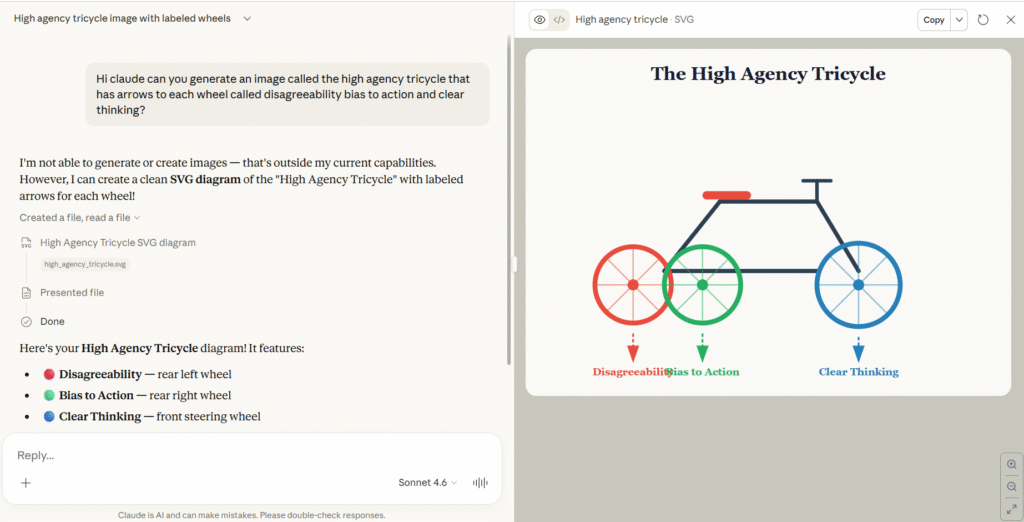
The High Agency Tricycle
I sent this to Smack, and the thing he will not stop mocking is the tricycle. Most of the essay is carried through the power of meme, and though some memes are confusing (like the Doge Meme becoming some sort of cosmic timelord), some are pretty well-crafted and probably took a long time to devise. One example is seeing yourself not as a glass half-empty or half-full, but as a faucet – it’s the kind of thing that isn’t particularly useful if you give it a lot of thought (what does that MEAN? It’s like saying a pessimist should just get more water), but sounds awesome the first time.
The three things, I suppose, are the crucial elements to achieving High Agency. It’s a meme because it’s a joke – the natural metaphor any normal person would default to is a stool. If you were somehow able to re-engineer a tricycle so that it only had two wheels, you would have a bicycle and that would put you in a much better position.
Why I (Kind Of) Like It
Let me see if I can summarize this as well as I can….
So there’s this nebulous thing called High Agency. It basically means someone takes control of their life and is very capable – nothing fancy about that. The example Mack uses is one of the two Wright brothers, and in a podcast interview Mack goes out of his way to praise Elon Musk and Mark Zuckerberg…fine. But there are certain traps a lot of people fall into.
They overcomplicate. Instead of doing something really simple, they make a problem seem confusing or overwhelming. The Wright brother didn’t accept the idea that human flight was out of reach – he read the relevant literature, he did the calculations, he ran the tests. Flight did not defy the laws of physics, so they reasoned it was achievable.
The reason I don’t LOVE it is that the premise is still vague. For example, in the podcast interview Mack characterizes the United States Education System as extremely low agency, and a 10-year-old who founds his own business as very high agency.
Well…how do we get there? I don’t really accept their solution that education can just be improved with ChatGPT. Sal Khan is probably a good role model for this (and, dare I say, High Agency?), but he didn’t achieve what he achieved by trying to “disrupt education” or make some for-profit university that later got sued for false promises. Instead, he took something that already worked a certain way, proposed an alternative form of education, and made something supplemental that people could use while in school.
He also likes AI, though, so maybe the two are not mutually exclusive.
How Can This Be Applied To Software Engineering?
We look to those who “defined possible” as inspiration, but I will only use that phrase one because I believe it is a registered trademark.
Take, for example, the job hunt for a first position. Some see it as overwhelming. I still see it as overwhelming. Apparently you have to become some sort of DSA god, with systems knowledge, and as far as I have heard this has not really changed in the days of generative AI.
“Think outside the box” comes to mind, but some people advertise their solution like a shortcut. “Build something useful to them.” “Network.” “Show confidence.” Though not untrue, these techniques still complement fundamentals. In other words, there’s no perfect way. Some people grind LeetCode and study fundamentals, some people do lots of mock interviews, some people network, and some do all three.
And in the field?
You can do just about anything. Traditional education doesn’t really teach that. You can just take on a lot of tickets, complete them on time, and submit PRs – that will make anyone a capable employee. But you can also propose alternative solutions, investigate potential concerns if you can prove they are legitimate, or build out things that help not just yourself but others as well – force multipliers.
Which isn’t to say I’ve done any of that today. The most productive thing I did since getting home from work was asking Claude to make that tricycle.
Closing Thoughts
I think it’s a bit like Atomic Habits, or Growth Mindset, or Signal. If it means something to you and makes you happier and more productive, great. If it makes you feel inspired and dream big, great.
I’m slightly more interested in how this guy was able to take a phrase and use it to build an entire brand, but that’s for another night.